
Ads in ChatGPT: Can you just buy AI visibility now?
Since August, ChatGPT has been showing ads in Germany too, and many companies are hoping for a shortcut to AI visibility. Here's why an ad next to the answer is not the same as a recommendation in the answer, and why that is good news for PR.
Ever since ChatGPT started showing ads in Germany, I keep hearing the same line, sometimes as a question, sometimes as a statement: "Fine, we'll just run ads in ChatGPT. That makes us visible in AI."
I get the reflex. It's convenient. GEO sounds like work, like lots of stakeholders, like results you can't get at the push of a button. An ad, on the other hand, comes with a budget, a timeframe, and a dashboard. But that line of thinking has a flaw: being visible next to the answer is not the same as being recommended in it.
In October 2026, I attended an OpenAI webinar titled "Die Entscheidung ist die Chance: ChatGPT Ads, ein neuer Kanal für Marketingfachleute" (roughly: "The decision is the opportunity: ChatGPT Ads, a new channel for marketers"). Two points stuck with me. First, OpenAI makes the case for ads with the new customer journey: people increasingly research, compare, and decide right inside the chat, and that moment of decision is supposed to become an opportunity for advertisers. Second, running ads, until now a kind of foreign language for specialists, is supposed to become something any company can do, thanks to AI.
At a glance
- The facts: Since August 24, 2026, ChatGPT has been showing ads in 31 European markets, including Germany and Austria. Only users on the Free and Go plans see them.
- What money can't buy: According to OpenAI, advertising does not influence ChatGPT's answers. The ad sits next to the answer, clearly labeled. There's no way to buy the recommendation in the answer.
- The difference: The ad says, "Here I am." The answer says, "You should take a look at this one." It's the old split between paid and earned media, except that AI now plays the role of the editor.
- When ads make sense: when purchase intent is clear, as a bridge while you're still missing from the answers, and as a way to learn which questions your audience asks.
- The real danger: that in budget discussions, ads crowd out the long-term work on credibility. Especially in B2B, a large part of the audience never sees an ad at all.
What are ads in ChatGPT, and when did they launch in Germany?
Ads in ChatGPT are labeled placements that appear separate from the answer itself. Since August 24, 2026, they have been running in 31 European markets, including Germany and Austria. OpenAI started with a test in the US in February 2026.
Here are the key facts:
- Who sees ads: only users on the Free and Go plans. Plus, Pro, and Enterprise users stay ad-free.
- Where they appear: separate from the answer text and clearly labeled. OpenAI says ads are always labeled and kept separate from the answers, "… and advertising does not influence the answers ChatGPT provides."
- How to book them: through major agency groups such as Publicis, Omnicom, and WPP, and since August 31, 2026, also on your own through the self-serve Ads Manager. Billing is per click or per impression, and according to Digiday, most of the spend goes to clicks. On top of that, there's conversion optimization and pixel-based measurement.
- The promised reach: According to OpenAI, ChatGPT has more than 900 million weekly users, and about 20 percent of queries show direct purchase intent.
In the US, ChatGPT ads are already routine. The tracking service Cloro found that in the seven days through July 3, 2026, just over half of all answers on the Free and Go plans contained an ad: 51 percent. The figures swing sharply from week to week, though. According to Reuters, the ad business had reached an annualized $1 billion in revenue by the end of August. This is no longer an experiment. It's a new advertising market.
Why is an ad next to the answer different from a recommendation in the answer?
Because the ad only signals presence, while the answer makes a recommendation. Anyone who asks ChatGPT a question will now see two things: the answer and, next to it and clearly labeled, possibly an ad.
It's a bit like Google, where paid ads have sat above the organic results for decades. But the comparison breaks down at one crucial point. On Google, the organic result was a list of links. In ChatGPT, it's a recommendation. The AI compares, puts things in context, names vendors, and sometimes says very plainly which one fits best.
The ad says, "Here I am." The answer says, "You should take a look at this one." OpenAI itself has committed to keeping money out of the answer. So you can't buy a place in the answer. You have to earn it.
What do ads in ChatGPT have to do with paid and earned media?
A lot: ChatGPT ads repeat the familiar split between paid and earned attention, except that AI now plays the role of the editor. For PR people, this is old news.
Newspapers have always run ads on the same page as articles where a journalist speaks well of your company. Everyone knew which of the two carried more credibility. The article was worth more precisely because you couldn't commission it.
In ChatGPT, the AI decides who deserves a recommendation. And it leans heavily on what others say about you: trade media, experts, review sites, studies. That's why ads don't make the answer less important. They make it more valuable, because the answer now has a visible counterpart.
Are ChatGPT ads still worth it?
Yes, for some companies and in certain situations. I'm not against advertising. It has its place. Here are three cases where ChatGPT ads can make sense:
- When purchase intent is clear. Someone asking about a specific product is close to a decision. An ad can shorten that last step.
- As a bridge. If you don't show up in the answers yet, an ad can create presence while the organic work is underway.
- As a learning tool. The data shows which questions your audience actually asks. That's valuable for content and PR, too.
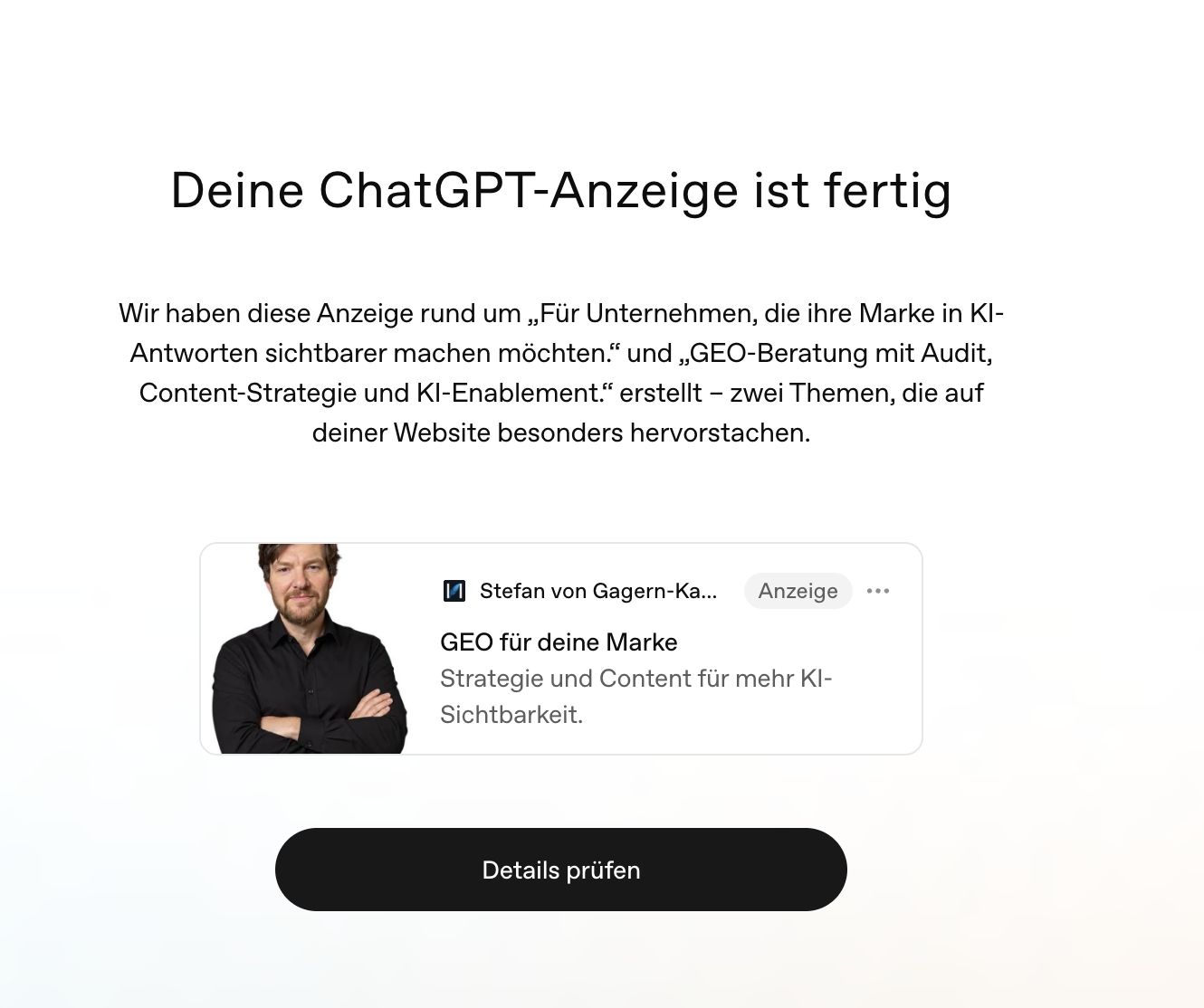
I tried running an ad for myself in the new Ads Manager. It really is easy and takes just a few clicks. But that's exactly where the temptation lies: an ad doesn't replace a recommendation. It's a roadside billboard, not a tip from a friend.
Why is the real danger in the budget discussion?
Because ads are easy to book, measurable, and fast, while GEO and PR pay off over the long term, are harder to measure, and require alignment across many departments. When management asks why you're doing it the hard way when you could just run ads, you need a good answer. Here are four arguments:
- Ads only work as long as you pay. A strong position in the answers builds over time and lasts.
- Not everyone sees ads. Anyone on a paid plan sees no ads at all. In a professional setting, that's likely a large part of your audience, which is an important point for B2B.
- Ads don't explain why. The answer comes with its reasoning built in: why this vendor, for whom, with which strengths. That's exactly what decides who makes the shortlist.
- If you're missing from the answer, an ad almost looks suspicious. When the AI recommends three competitors and you only show up next to them as an ad, that's not a strong signal.
What do ads in ChatGPT mean for PR and communications?
For communications departments and agencies, this development is a real opportunity, for three reasons.
Earned media gets a new argument. The answer can't be bought. It comes from credibility and presence in relevant sources. That's a core PR skill.
PR and performance marketing belong at the same table. If you book ads, you should know what AI says about your company without them, and vice versa. To make that work day to day, the team needs a shared understanding, and that is exactly what content enablement for GEO is about.
And it pays to know where you stand right now. Before any budget goes into ads, you should be clear on how the answers portray your company today. That assessment is the core of a GEO audit and the basis for any sound budget decision.
Conclusion: You can buy visibility. You can't buy a recommendation.
ChatGPT ads are a new and interesting channel, and they'll find their place in the marketing mix. But they don't solve the real problem. The real problem is whether AI recommends you when your customers ask for a solution. No ad budget has a direct say in that. Good communication does.
Ready for a GEO check?
Wondering what role AI search plays for your business and whether getting started with GEO would pay off? In a free 15-minute GEO quick call, we'll look together at what GEO can do for you. This post first appeared in the GEO-Briefing, my LinkedIn newsletter on AI visibility, which is published in German.
→ Subscribe to the GEO-Briefing on LinkedIn (in German)
Frequently asked questions
When did ads in ChatGPT launch in Germany?
On August 24, 2026. Since then, ChatGPT has been showing ads in 31 European markets, including Germany and Austria. OpenAI had started with a test in the US in February 2026.
Do ads influence ChatGPT's answers?
Not according to OpenAI. Ads appear clearly labeled and separate from the answer text. You can't buy a place in the answer, that is, the AI's recommendation. It comes from credibility and presence in the sources the AI relies on.
Who sees ads in ChatGPT?
Only users on the Free and Go plans. Plus, Pro, and Enterprise users don't see ads. That's why, especially in B2B, ChatGPT ads miss part of the audience entirely.
Do ChatGPT ads replace generative engine optimization?
No. Ads create presence next to the answer, while GEO works on the recommendation in the answer. Ads only work as long as you pay, while a strong position in the answers builds over time and lasts. The smart move is to do both, with clear roles.
Sources
What does AI say about you today?
Before any budget goes into ads, it pays to know where you stand. In a free GEO check, we'll look together at how your brand shows up in AI answers today.
Book a free GEO check
About the author
Stefan von Gagern ist KI + Content Consultant in Norderstedt. Er begleitet Unternehmen seit dem Start von ChatGPT im November 2022 bei KI-Strategie, Enablement und Generative Engine Optimization, hat über 500 Marketer geschult und die erste KI-Content-Marketing-Akademie Deutschlands geleitet.
→ More about Stefan