
ChatGPT Business Hub and Gemini 4 in Google Search: What November 2026 changes for your AI visibility
Between November 10 and 12, Google and OpenAI noticeably changed AI search: Gemini 4 Hydrogen now powers Google Search, and for the first time, companies can create their own profile in ChatGPT. What that means for GEO and what you should do now.
Within three days, the two most important platforms in AI search changed something fundamental. On November 10, OpenAI launched the Business Hub, which for the first time lets companies create their own profile in ChatGPT. On November 12, Google brought its new model, Gemini 4 Hydrogen, to Search. In other words, Google is changing how people search. OpenAI is changing who gets a say.
On top of that, Semrush has released fresh numbers on how much search really runs through AI already. All three stories directly affect how companies show up in AI answers. Here are the key points, put in context from hands-on GEO work.
At a glance
- Google: Since November 12, 2026, Gemini 4 Hydrogen has been powering Google Search worldwide as the default model in AI Mode. Google breaks questions down into subquestions more heavily and promises a wider range of links.
- ChatGPT: Since November 10, 2026, companies can use the Business Hub to claim and manage their profile in ChatGPT and, for the first time, see data on how often they are mentioned. Free for now, and in beta.
- Not a ranking lever: According to OpenAI, a claimed profile does not change how often a company appears in answers. Your own website remains the main source.
- The numbers: According to Semrush, use of AI tools grew 79 percent in one year. Traditional Google Search is still about seven times bigger.
- The takeaway: If you answer your customers' questions in depth, you win in Google and in ChatGPT at the same time.
What does Gemini 4 Hydrogen change about Google Search?
Since November 12, 2026, Gemini 4 Hydrogen has been the new brain of Google Search, worldwide and for all users. Robby Stein, head of product for Google Search, writes on the Google blog: "This is the biggest model upgrade to Search yet."
Hydrogen is the fast, efficient model in the new Gemini 4 family. Google calls it the "daily driver." Its bigger siblings, Carbon and Argon, are designed for long, difficult reasoning tasks. According to Search Engine Journal, Hydrogen is the new default model in AI Mode. In AI Overviews, according to Robby Stein, it answers the hardest questions. Google doesn't say exactly which ones those are.
For users, four things change most:
- Better understanding of questions: Search is supposed to handle multipart questions, typos, and very specific queries much better.
- More sub-searches: Google breaks questions down into subtopics more heavily and searches for each one in parallel, a process known as query fan-out.
- More links: According to Google, this is meant to lead users to "a broader range of helpful links than before," including pages they wouldn't have found otherwise.
- More visual answers: more images, comparison tables, structured answers, and small tools generated on the fly.
Why does query fan-out matter so much for GEO?
Because a question that has been broken down needs several good answers, not just one. When Google splits a question into five subquestions, it gathers five answers. Each one is a potential spot for your company.
That's an opportunity for everyone who covers their topics in depth. If you clearly answer questions about requirements, costs, comparisons, and use cases, you offer lots of points where the answer can connect to you. If all you have is a general overview page, you offer one. How to build that kind of content is the core of SEO and GEO copywriting.
One practical note: The November core update also started on November 10. If you're seeing changes in your visibility right now, it's hard to tell what comes from the core update and what comes from the new model. Search Engine Journal recommends documenting the two time frames separately. Good advice.
What is the ChatGPT Business Hub?
The Business Hub is where, since November 10, 2026, companies can claim and manage their own profile in ChatGPT. OpenAI launched it as a beta. TechCrunch aptly compares it to the business profiles people know from Google.
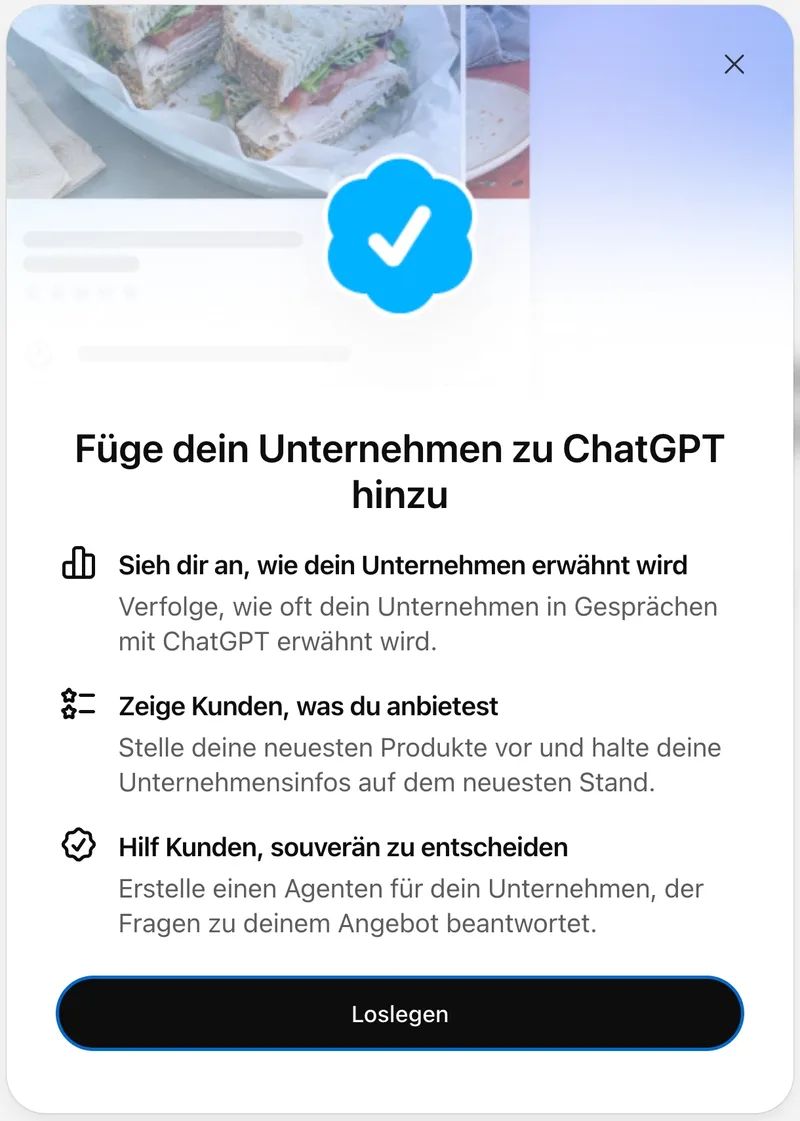
OpenAI itself describes ChatGPT as "the platform for people and businesses to connect through AI" and calls the hub an early step toward bringing businesses deeper into ChatGPT. Here's how it works:
- Claim your profile: At chatgpt.com/business-hub, you search for your company and verify ownership, for example through your business phone, a DNS record, a business email address, or Shopify. After an identity check, you get a blue check mark.
- Manage your information: website, description, category, logo, cover image, shipping and return policies, and for retailers, a product feed with prices and availability. OpenAI reviews every change, and the information has to match your own website.
- Get data: Under "Insights," you can see for the last 28 days how often your company was mentioned in ChatGPT, how many clicks went to your website, and for which topics.
- Your own agents: Companies can launch a business agent that answers questions about their products inside ChatGPT. For now, this is only available to online stores and online services in the US.
- Cost: free for now. OpenAI has not ruled out a paid model.
Does a Business Hub profile give you more visibility in ChatGPT?
No, not directly. According to Digiday, Benji Shomair, head of monetization at OpenAI, says clearly that a claimed profile does not change how often a company appears in answers. Better information can, however, help you get found in relevant conversations. If you were hoping for a shortcut, there isn't one here either.
Your own website remains the main source. The profile has to match the website, and for online businesses, a mention only counts if ChatGPT cites your own website. The brand name alone isn't enough. For local businesses, it counts when ChatGPT shows a result for the location. That fits what we've been seeing since August: ChatGPT goes straight to companies' own websites. Whatever is unclear, outdated, or contradictory there ends up in the answer, too.
What I find more exciting is something else: finally, there's data from the source. Until now, we could only estimate AI visibility with third-party tools. Now OpenAI provides numbers itself, even if they're rough and only cover ChatGPT. For the nagging question "How do we measure GEO?", that's real progress, especially as a complement to the baseline from a GEO audit.
A word of caution: Once a profile is published, it can't be deleted. Only drafts can. Even OpenAI support can't hide it. So fill it out carefully, using a company account, not a personal one. To find out whether the feature is already available for your company, take a look at chatgpt.com/business-hub. OpenAI has not published a list of countries.
How much search already runs through AI?
More than it did a year ago, but far less than is often claimed. That's what Semrush's State of Search Report for the third quarter of 2026 shows, with commentary from SparkToro founder Rand Fishkin. It's based on desktop usage data from the US and 32 European countries.
- AI is growing fast: Use of AI tools grew 79 percent within one year and reached a new high. In the US, their share of desktop usage rose from 0.72 to 1.29 percent.
- Google is still much bigger: According to Semrush, traditional search is still about seven times bigger than AI tools.
- Organic clicks are recovering: Their share on Google reached its highest level of the 15-month study period in September, at 46 percent in the US.
- Search queries are turning into prompts: Queries on Google are getting longer and more conversational. More and more, people type the way they talk to ChatGPT.
These numbers are a good antidote to two exaggerations. One says, "Google is dead." It isn't. The other says, "AI is a niche topic." With 79 percent growth in one year, it isn't that either.
Are SEO and GEO blurring together?
Yes, and that's the real news this week. When people ask Google questions the way they ask ChatGPT, and Google answers those questions with Gemini in AI Mode, the line between SEO and GEO blurs.
It's no longer about Google or AI. It's about having the best answer to the questions customers ask, wherever they ask them. That's less a technical task than an editorial one: knowing your customers' questions, explaining your own offering clearly, and providing evidence. For a team to keep that up over time, it needs shared ways of working, and that's what content enablement is about.
Conclusion: Two platforms, one direction
Google is searching more broadly and more deeply. OpenAI is bringing businesses directly onto its platform. And the data shows that the two are growing together rather than pushing each other out. Here's what that means for you in practice:
- Answer your topics in depth, not just at overview level. That's exactly what benefits from fan-out in Google Search.
- Claim your ChatGPT profile as soon as it's available to you. Carefully, and with a company account.
- Use the new data. The insights in the Business Hub are your first official look at your visibility in ChatGPT. Compare them with your own numbers.
- Document the week of November 10. Core update and new model at the same time: If you want to understand later what changed, you need clean before-and-after data now.
Ready for a GEO check?
Want to know what these developments mean for your business? In a free 15-minute GEO quick call, we'll look together at what GEO can do for you. This post first appeared in the GEO-Briefing, my LinkedIn newsletter on AI visibility, which is published in German.
→ Subscribe to the GEO-Briefing on LinkedIn (in German)
Frequently asked questions
What is the ChatGPT Business Hub?
An area in ChatGPT where, since November 10, 2026, companies can claim and manage their own profile, with a logo, description, website, and for retailers, a product feed. It also provides first data on how often the company is mentioned in ChatGPT. The hub is free for now and running as a beta.
Does a Business Hub profile improve my visibility in ChatGPT?
Not directly, according to OpenAI. A claimed profile does not change how often a company appears in answers. Accurate information can, however, help you get found in relevant conversations. Your own website remains the most important source.
What is Gemini 4 Hydrogen?
The fast, efficient model in Google's Gemini 4 family. Since November 12, 2026, it has been active in Google Search worldwide and is the default model in AI Mode. Google calls it the biggest model upgrade to Search yet.
What is query fan-out?
Google breaks a question down into several subquestions and searches for answers to each one in parallel. With Gemini 4 Hydrogen, Google does this more heavily than before. For companies, that means if you clearly answer many subquestions about your topic, you have a better chance of showing up in the answer.
Has AI search made Google obsolete?
No. According to Semrush's State of Search Report for the third quarter of 2026, traditional Google Search is still about seven times bigger than the use of AI tools. But AI use grew 79 percent within one year.
Sources
- Google Search gets a major upgrade with Gemini 4 Hydrogen
- Introducing Gemini 4 Hydrogen
- Google Makes Gemini 4 Hydrogen The Default Model In AI Mode
- OpenAI rolls out new business profiles, making ChatGPT just a little bit more like Google
- Setting up your business on ChatGPT
- OpenAI Launches Businesses in ChatGPT: Business Hub Claims, Mention Data and Business Agents (with statements from OpenAI to Digiday)
- ChatGPT Business Hub Setup: Step by Step, and 10 Things to Watch
- State of Search Report Q3 2026
- AI Tools Grew 79% in a Year. Google Search Is Still 7 Times Bigger
- Google organic click share reaches 15-month high: Report
What do these developments mean for you?
In a free 15-minute GEO check, we'll look together at how your brand shows up in AI answers today and where getting started pays off.
Book a free GEO check
About the author
Stefan von Gagern ist KI + Content Consultant in Norderstedt. Er begleitet Unternehmen seit dem Start von ChatGPT im November 2022 bei KI-Strategie, Enablement und Generative Engine Optimization, hat über 500 Marketer geschult und die erste KI-Content-Marketing-Akademie Deutschlands geleitet.
→ More about Stefan